

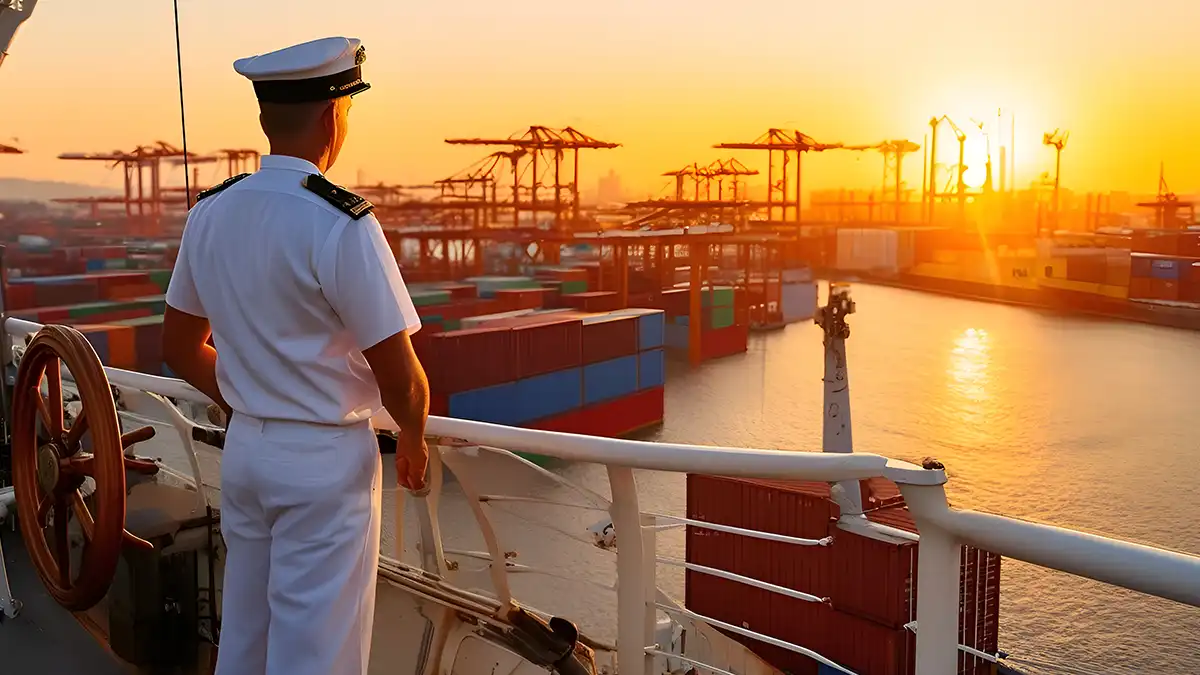
Hello readers! Imagine waking up in the middle of the ocean, watching the sunrise over endless water while working on a massive ship that travels across continents. Few careers offer this kind of adventure, responsibility, and global exposure. One such career path is the Merchant Navy.
Many students feel curious about the Merchant Navy, especially after seeing videos about high salaries and international travel. However, the profession requires proper training, discipline, and strong technical knowledge. If you want a career that combines engineering skills, leadership, and travel opportunities, this profession can become an exciting option.
But before getting into this profession, you need to know the pros, cons, and all the other essential aspects of this profession. This blog today would act as a useful guide for you in this regard. Know everything there is to know about this profession for your convenience.
What is the Merchant Navy?
The term ‘Merchant Navy’ refers to the profession dealing with a fleet of commercial vessels used by many different businesses to transport people and/or their products throughout the world. This group of ships is responsible for carrying the majority of the world’s cargo by distributing essential items, including oil, automobiles, machinery, and food, between countries.
It operates a large number of Ships on all the seas of the world, including cargo vessels, oil tankers, container vessels, and cruise ships. Skilled personnel manage the vessels. And if they fail to deliver their shipments to their destination safely and without injury to the crew.
This field’s purpose is to trade and ship goods globally; whereas, the primary purpose of a country’s naval forces is to protect its own territory.
How Many Departments are There?
Ship operations in the Merchant Navy have three departments.
Deck Department
Navigating and operating the ship on board takes place in the deck department. The officers are responsible for managing all aspects of the operations, including the use of navigation equipment (i.e., radar/sonar), route planning, and safety monitoring.
Engineering Department
The maintenance of all the ship’s machinery – engine, mechanical systems, and electrical/mechanical equipment – is performed by engineers employed in the Engineering Department. Engineers must guarantee that all machines work correctly for long periods to maintain operational excellence.
Catering Department
The catering department is responsible for food and all other requirements needed to maintain the daily living needs of crew members. It helps ensure the crew’s health and comfort while at sea for long durations.
All three departments are essential for the continuing operation of the Merchant Navy.
Career Opportunities in the Merchant Navy
The Merchant Navy has a variety of career options, which depend upon education and training. Most people enter as cadets or trainees, progressing to higher levels over time through experience, training, and certification.
There are two main career paths available to audiences entering this profession: deck department careers and engineering department careers. Each department offers excellent opportunities for professional growth.
Career Path for the Deck Department
The Deck Department specializes in navigation and vessel operations. Many students who opt for this path do so due to the ultimate goal of becoming a captain.
The Merchant Navy promotion path typically starts with a position as a Deck Cadet. Once the required certification exams are successfully completed, cadets may advance through the following positions: Third Officer, Second Officer, Chief Officer, and finally, Captain.
Career Path for the Engineering Department
Students who are interested in Technical Systems often choose Marine Engineering.
As in Deck, the Engineering Career Path begins with a trainee marine engineer position within the Navy. Upon completing the required certification exams, Engineers may then advance through the following positions: Fourth Engineer, Third Engineer, Second Engineer, and Chief Marine Engineer.
Overall, there is a tremendous opportunity for Career Advancement in both Departments.
Merchant Navy Qualification and Eligibility
Education plays an important role in fulfilling the requirements of entry into the Maritime Industry. All applicants must meet the academic requirements and the physical requirements.
Prospective applicants frequently inquire about the Navy qualifications required for admission into various Maritime Courses. The applicants must have completed their 12th Grade with Physics, Chemistry, and Mathematics.
The age criteria are also important. Most training programs are open to applicants between the ages of 17 and 25.
A candidate is required to be physically fit and pass various medical examinations, such as health checks, eyesight tests, etc. This is the first and foremost basic criterion to get an entry in this job.
How to Join Merchant Navy After 12th?
College Students are eligible to apply to selected maritime institutions that provide courses (e.g., Bachelor of Science (B.Sc) Nautical Science, 2-Year Diploma in Nautical Science and Marine Engineering). The maritime institutions provide students confined to the mariner field with instruction as to how to navigate and practice developed safety rules while-on-board vessels.
While undergoing training at any of these maritime institutions, students have access to state-of-the-art simulators and technical labs to gain hands-on experience on shipboard activities. Upon receiving their degree/a diploma, a graduate becomes eligible for employment aboard the embarkation.
Available Courses
| Course | Duration | Entry Level Position |
| Marine Engineering | 4 years | Engine Cadet |
| BSc Nautical Science | 3 years | Deck Cadet |
| GP Rating Course | 6 months | Crew Member |
| Diploma in Nautical Science | 1 year | Deck Trainee |
If you wish to know how to join Merchant Navy, you must focus on opting for the right maritime institutes to gain practical sea training.
The Salary and Earnings in India
Merchant Navy salary is one of the main USPs that attracts so many candidates towards this profession. So the salary is one of the most contributing factors towards grabbing the attention of the candidates applying for this profession.
The income and earnings depend on rank, experience, and the specific shipping company. Beginners generally earn moderate salaries, but as you gain experience over the years, you keep getting huge salaries.
Ranks and Salaries
| Rank | Average Monthly Salary |
| Captain | ₹6,50,000 to ₹10,00,000+ |
| Chief Officer | ₹4,00,000 to ₹6,00,000 |
| Second Officer | ₹2,50,000 to ₹3,75,000 |
| Third Officer | ₹1,50,000 to ₹3,00,000 |
| Deck Cadet | ₹25,000 to ₹85,000 |
Senior officers, such as captains and chief engineers, can make upwards of several Lakh Rupees a month based on their level of experience and the shipping company they are employed with.
Other advantages include international travel, living on board a vessel, and taking long periods of vacation between contracts.
Work and Lifestyle
The lifestyle is very different from a normal day at work for a crew member in the Merchant Navy. They are at sea for months at a time, working on cargo vessels and oil tankers. Because there are continuous operations on board a vessel, all officer staff work in a rotating shift schedule.
Most people who work in the Navy will typically travel to several different countries during their careers, therefore constantly being exposed to various cultures and ports around the world.
Conversely, there is a requirement for significant mental fortitude to be successful. Crew will spend several months away from their family while working through adverse weather conditions.
Even with the challenges, many choose to pursue this field as there is excitement and financial benefit associated with this type of profession.
For many, staying away from friends and family for 8-9 months a year is one of the main downsides of this profession. It becomes quite difficult to manage a healthy work-life balance for this reason. But individuals who can adjust to this aspect are bound to make real career strides in this profession.
Pros and Cons of Working in the Navy
Pros
The high earnings compared to other traditional careers. The average salary is significantly higher than that of other professions out there, which compensates for the risks and hard work required to perform in this profession.
Another pro is that people who work on ships around the world are exposed to many different cultures.
A third advantage is that many veteran seamen have long periods off from their jobs between contracts.
Cons
First, those working in this field may spend several months away from home.
Secondly, the work schedules can be quite rigorous, especially when a ship meets adverse weather conditions.
For individuals who enjoy adventure and discipline, this profession can be an extremely gratifying career. Hence, if you wish to have a challenging and yet rewarding career, then this profession could be the field that you are looking for.
Conclusion
The Merchant Navy is one of the most diverse and exhilarating careers available today. It combines technical expertise with international travel and earning potential.
Thus, any individual who is interested in both adventure and engineering can create a prosperous career in the Navy, so long as they receive the requisite training and remain dedicated to their goals.
If an individual remains focused on developing their physical fitness, completing the appropriate training, and enhancing their technical capabilities, the Merchant Navy can provide an individual with a rewarding career that is held in worldwide esteem.
FAQs (Frequently Asked Questions)
Q1. What is the Merchant Navy?
The term ‘Merchant Navy’ refers to the use of commercial vessels/ships for transporting commercial cargo/goods between ports around the world.
Q2. What is the salary for freshers?
The average starting salary for freshers is between ₹25,000 and ₹85,000 in India.
Q3. What qualifications are needed to be in the Navy?
To qualify for this profession, you must have completed 12th grade with Physics, Chemistry, and Mathematics.
Q4. What is the Merchant Navy age limit?
As per the age limit for Navy courses, the average age limit is 17-25 years.
Q5. How to become Merchant Navy?
Students can apply for maritime institutions and follow the required steps to join after 12th after graduating from high school.
Also Read:
Romanian Deadlift- The Best Deadlift Variation
VeganovTrichy.com: 5 Essential Social Media Growth Tips for 2026

I am Gourab Sarkar, a professional Content Writer and Blogger based in Kolkata with over 8 years of experience in delivering SEO-driven, engaging, and audience-focused content.