

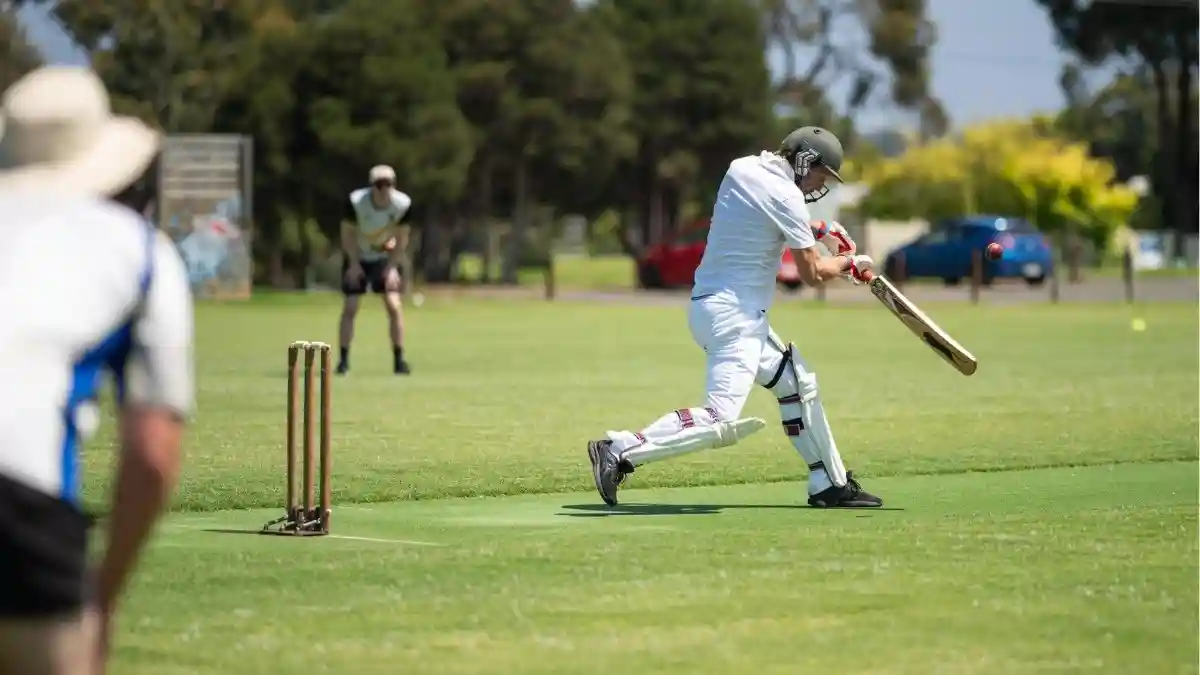
Hello readers! Are you one of those cricket fans who watch cricket but are puzzled about the lines of pitch? Well, you are not alone. There are many others who feel the same. It is common to focus on batsmen, bowlers, fielders, and umpires, but you also need to know the rules of the game to understand cricket better. In order to learn cricket, you have to ask the right questions first. In this regard, one common question most of the cricket enthusiasts, or beginners, have in their mind is, ‘how many creases are there in cricket’.
Whether you are a cricket fan, a young player, or someone who just likes to watch cricket matches, it is essential for you to know the answer to this important question. In this guide today, you will know how many creases a cricket ground has, how they are utilized during a match, etc.
You will also explore different types of cricket creases, how they impact the game of cricket, and what their purposes are. This is why you are required to understand cricket in the best way possible. You must know about ‘how many creases are there in cricket pitch’.
How Many Creases are There in Cricket: What is a Crease?
The painted white line portion that you see on the pitch is known as a crease. It sets a limit for certain players’ moves. It is not only aesthetically pleasing but is also used as a marker for the safe playing areas of the batsman, a visual reference point for the umpires, and playing space for the bowler.
Let us take the safety line and the finishing line into account. As long as the batsman plays their move within the popping crease, there will be no threat of getting run out on the hands of the fielders. Conversely, the bowlers have to remain within the bowling crease before delivering the ball to the batsmen.
Thus, the role of the creases is to set boundaries to the pitch and make sure the batter and bowlers follow certain rules.
How Many Creases does a Cricket Pitch Have?
There are 8 creases in a cricket pitch. You might be confused at first to have heard of this many types of creases in cricket. But if you know closely, you will realize that these are nothing but 3 main types of lines, painted at both ends of the pitch.
The 8 creases are:
- 2 Bowling creases (one at every end of the pitch)
- 2 Popping creases (one at every end of the pitch)
- 4 Return creases (two at every end of the pitch)
All these creases have specific purposes that define rules for bowling, batting, and fielding. The rules of the game would not work out without the existence of these creases. Hence, you can understand their importance.
What Types of Creases Does a Cricket Pitch Have?
There are 3 types of cricket creases, consisting of a total of 8 in total. Each of these creases has a unique and clear role- from exhibiting where a batsman needs to stay to be safe to marking the region where the bowler should deliver the ball.
The 3 types are:
- Popping Crease
- Bowling Crease
- Return Crease
Each of these creases is used uniquely. But in totality, these creases ensure fairness and control the movement on a cricket pitch.
Popping Crease
The popping crease is perhaps the most vital crease used by the batsmen. This is 4 feet away from the bowling creases and stays parallel to them.
All run-outs and stumpings decisions are made using this crease line.
Why Should Batsmen Know the Popping Crease?
The batsman stays safe until they are not completely out of this line.
If they have a part of their body or bat behind this line after removing the bails by fielders, the batsman is ruled as ‘out’.
Therefore, this crease is very frequently talked about in the games played.
Role of Popping Crease in Running between the Wickets
When running between wickets, all batsmen need to run across this crease at the other end of the field.
The Bowling Crease
The bowling crease is the basic line used in making marks on the cricket pitch. It stretches down the middle of the stumps and has a length of 8 feet 8 inches.
Umpires use this line to evaluate various things about the delivery.
Importance of the Bowling Crease
The bowling crease helps in determining whether the delivery was made from the right position. The line is the one that helps to determine where the stumps should be placed.
In its absence, it would not be easy to maintain uniformity across different grounds.
Position of the Bowling Crease
The line stretches straight down the middle of the middle stump to both sides.
Return Crease
There are two return creases at each end of the pitch. These creases are perpendicular to the bowling crease.
They serve to mark out the legal zone for the bowler to bowl the ball from.
Significance for Bowlers
The back foot of the bowler should always be inside the return crease when delivering the ball.
In case it is not, the umpire can award a no-ball to the delivery.
This will prevent any bowlers from getting an advantage from the angle at which the ball was delivered.
Length of the Return Crease
The return crease stretches beyond the bowling crease. This ensures the bowlers have enough room for delivery without compromising on fairness.
Why are Creases Important in a Cricket Pitch?
Although the creases may be considered simple markings, they affect almost all aspects of the game.
Fair Play
These markings give a clear boundary to the players.
It makes sure that the bowlers play fairly and assists the umpire in making accurate judgments.
If there were no creases, many rules in cricket would be unenforceable.
Making Correct Decisions
Cricket uses several tools, like Hawk-Eye and ultra-motion cameras, to help in making decisions.
These tools refer to the crease lines often when considering no-ball and dismissal calls.
Precision in such decisions requires precise marking of the crease lines.
Standardization of the Sport
All professional grounds for cricket follow certain standard sizes for the pitch and crease. This allows for standardization wherever the game is played.
The players always know what to expect when stepping on the pitch.
Effects of Creases on Various Types of Dismissal
Run Out
A run-out dismissal is one of the exciting moments of cricket. A runner needs to cross the popping crease before the stumps are removed.
Umpires need to determine whether the batsmen have crossed the popping crease in time.
Even slight discrepancies in measuring this action may decide the fate of the player.
Stumpings
Popping creases plays an important role in stumpings, too.
Should the batsmen fail to make it to the crease and the ball be missed, the wicketkeeper will be able to dislodge the bails.
As a result, the batsman will face vulnerability since he is outside the protection of the popping crease.
This regulation gives an opportunity to spinners to bowl out adventurous batters.
No Ball
Both return crease and bowling crease play an important part in making calls about whether the delivery is legal.
In case of any overstep from the designated line, a no-ball is declared. In modern cricket, cameras play a key role in making such decisions.
Precision of crease markings helps avoid confusion.
Evolution of Crease Markings Over the Years
A lot has evolved about the game of cricket over the ages. Crease marking, however, has been very consistent throughout its history.
Early Cricket
Crease markings in the early days of cricket were not as sophisticated or uniform. Each ground had slight variations.
With the development of organizing structures for cricket, uniform rules were established.
Modern Day
In today’s day and age, the MCC and ICC ensure that strict rules are followed.
Preparation of the grounds according to these rules is mandatory prior to all matches.
Examples of Crease Decisions in Real International Cricket
Crease-related incidents are what make cricket interesting and dramatic. A single inch is likely to decide defeat or victory. Some of the most unforgettable examples in real-life cricket are:
Dhoni’s Quickest Run-Out of Ross Taylor (India Vs New Zealand, 2016)
In a T20 game of India against New Zealand, Ross Taylor narrowly missed out on scoring runs as Dhoni broke the stumps at lightning speed when Ross Taylor was still in the process of touching the ground. This incident highlights how players should be cautious while playing in front of the crease.
2019 World Cup Final
In the 2019 World Cup final, between England and New Zealand, where the outcome was decided through a nail-biting endgame, run-outs and crease awareness proved decisive. Umpires thus had no choice but to go through frame-by-frame assessments in order to decide whether the batsmen were behind the crease. Every square inch of the crease mattered at the end of the day.
Common Misconceptions Concerning Cricket Creases
The Bat Is Not Required to be Completely Behind the Line
A batsman is required to get even a small portion of the bat behind the crease line to stay safe.
Many people wrongly believe that the whole bat has to go behind the line.
Merely Hitting the Air Does Not Work
The bat needs to touch the ground behind the crease. Just flying close to the crease line will do no good.
Creases are Relevant during the Entire Game
Some people mistakenly think that the creases have nothing to do with anything other than dismissals.
The truth is that creases matter for bowling, running, stumping, and everything else in every innings.
Conclusion
Cricket might seem to be easy when watching, but it requires great accuracy in following the rules. One of the ways to achieve fairness in the game, facilitate correct umpiring calls, and ensure consistency in every competition is through the crease markings at the wicket.
Have you asked yourself how many creases are there in cricket? Well, each end of the pitch features one bowling crease, one popping crease, and two return creases, thus forming four creases per end of the pitch or eight creases in total.
FAQs (Frequently Asked Questions)
Q1. How many creases are there in cricket?
A cricket pitch is 8 inches.
Q2. What is the role of these creases?
These creases define different roles for batsmen and bowlers.
Q3. What is the length of a cricket pitch?
A cricket pitch is 22 yards or 66 feet long.
Q4. Are creases important in a cricket match?
Yes, they are very important.
Q5. Does a cricket player need to know about the cricket creases?
Yes.
Q6. What is the cricket pitch length in feet?
It is 66 feet.

I am Gourab Sarkar, a professional Content Writer and Blogger based in Kolkata with over 8 years of experience in delivering SEO-driven, engaging, and audience-focused content.