

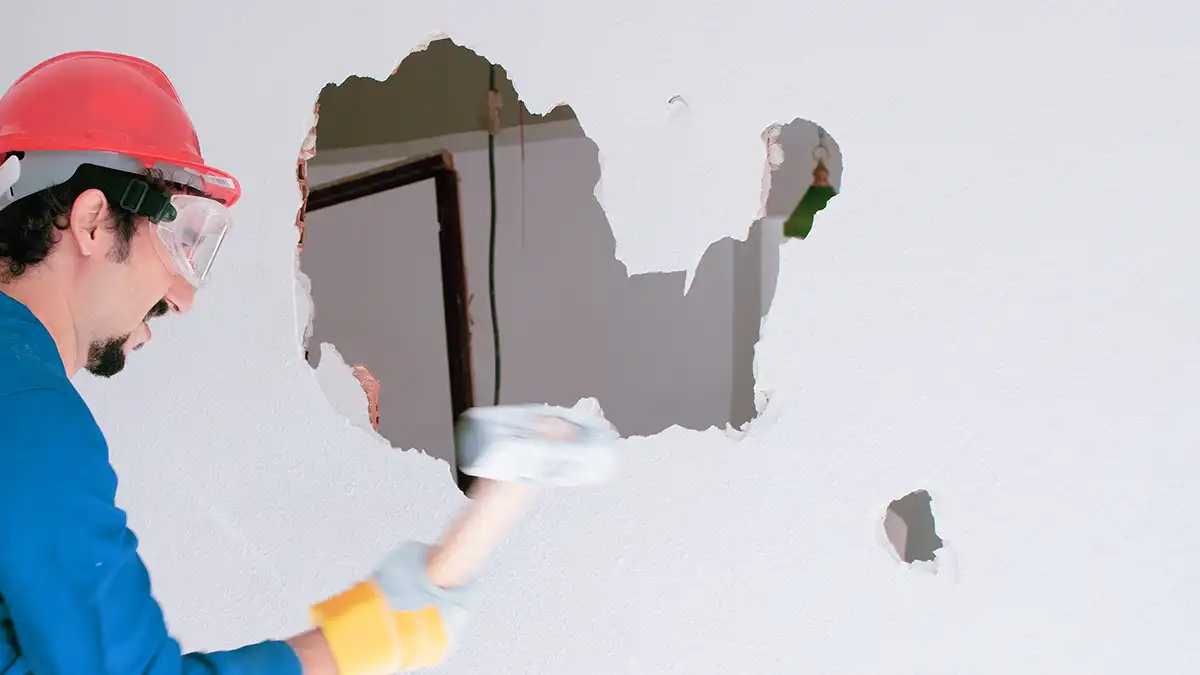
If you are someone who has been recently dealing with a lot of how to repair drywall questions, then this is the article that you need to know about the ways to easily repair it without any kind of hassle. In this article, we will not only be giving you some of the easy hacks for drywall repair, but will also help you to better understand the ways to do it. So, keep reading the article till the end to decode.
What is Drywall?
If you are looking to understand as to what drywall is, then let me tell you that drywall is essentially the material that your walls are made of, which involves patching cracks, holes, or dents, which are essentially used for spackling for the small damages or new drywall patches for larger holes. This will be followed by the application of the joint compound, sanding smooth, and followed by the painting.
Some of the key techniques include using adhesive mesh patches for medium holes, creating “California patches” for cleaner repairs, and feathering compound edges for an invisible finish.
Now that you have a good understanding of repairing drywall and the drywall definition, hop onto the next section of the article to decode the top ways.
How to Tips for Getting a Seamless Finish on the Dry Walls
If you are looking for some of the top tips to get a seamless finish on the dry walls, then here are the ones that you need to keep in mind:
California Patch
One of the top tips for getting a seamless finish on the dry walls is to use a California patch. Make sure to create a patch with paper backing that extends beyond the gypsum, allowing the paper to act as tape, which reduces the need for thick layers of mud.
Feathering
The next thing that you need to do is to use the feathering technique to get a seamless finish on your drywall repair. One of the feathering techniques that you can use is to apply a joint compound with a 6-inch or a much larger knife, thus tapering the pressure so you can compound the thickest over the hole, and also the thinnest on the edges.
Drying Time
The next thing that you can use to get a smoother finish is to have an ample amount of drying time. Make sure to use “hot mud” (setting compound) for faster, stronger repairs that can be sanded in an hour, rather than waiting 24 hours for traditional pre-mixed compound.
Finishing
Once the finishing is done, you can easily use the compound sand, which needs to be lightly fine-grit with sandpaper between the coats of the compound for ensuring a much smoother surface, and then make sure to prime the area before you even start painting the wall.
Now that you have got a good understanding of the ways to repair drywall, head to the next section of the article to decode the top pros and cons of the materials to use in the drywall repair.
What are the Top Advantages and Disadvantages of Using the Dry Wall Repair Materials?
Here are the top advantages and the disadvantages of the drywall repair ingredients that you can use to do the drywall repair.
Pros for Quick Set Mud
Faster Setting
One of the key pros of the drywall repair with the quick mud set is that it dries fast and also sets much faster. Additionally, if used in conjunction with fiber mesh tape, a repair can last a very long time. Not only that, it also comes in different sets for making it to accommodate the different size patches.
Not only that, another one of the key advantages of using the quick set mud is that it can be easily available, and also makes it an easy approach for dry wall repair.
Cons of using the Quick Set mud
Powdered Form
One of the cons of using the quick mud is that it essentially comes in powder form and will also require adding the mix of water to give it a correct ratio. Additionally, for some of the beginners, it will take ten mins for the beginners, and sometimes it can take up to 20 mins.
Additionally, it becomes quite harder to work as and when compared to the pre-mixed ingredients for beginners.
Now that you have got a good understanding of the drywall techniques, head to the next section to understand the easy wall repair techniques that you need to take into account before applying the drywall repair.
Top Dry Wall Repair Techniques
Here are the top drywall techniques that you need to know:
Small Holes
One of the key drywall repair techniques is to use the putty knife to press spackle or lightweight joint compound into the hole, let it dry, sand it smooth, and reapply if necessary.
Medium Holes
This is another one of the key drywall repair techniques that every beginner can use. Here, in this technique, it is important to apply a self-adhesive mesh patch over the hole, covering it with two or more layers of joint compound, feathering the edges to blend with the wall.
Large Holes
This is another one of the key dry wall repair techniques, which essentially includes large holes, and make sure to cut away the damaged area to the nearest studs, then, make sure to screw a new piece of the dry wall into the studs, and then, make sure to attach it to the wooden backer bands.
Nail Pops
The next thing that you need to do is to introduce the drywall technique with nail pops. Once done, you need to drive a new drywall screw 1-2 inches above the popped nail, and then tap the old nail in with the hammer. Then, you need to cover both the ones with spackle.
Top Reasons to do a Drywall Repair
Here are the top reasons to do a drywall repair:
Preventing Further Damage
One of the key reasons to do the drywall repair is to prevent any kind of damage. Make sure that there are no holes or cracks that can grow, allowing moisture to seep into the wall cavity, which leads to mold growth and, in some cases, severe structural deterioration.
Energy Sufficiency and Insulation
Gaps in walls cause air leaks, allowing heated or cooled air to escape, which makes your HVAC system work harder and increases utility bills.
Structural Integrity
Another one of the key reasons for the large holes, particularly those from damage or structural shifting, can weaken a wall. Repairs prevent, or in some cases fix, this weakness.
Safety Hazards
Damaged drywall can leave exposed electrical wiring, sharp edges, or insulation materials, which pose risks to children and pets.
Aesthetics and the Property Value
One of the key reasons for doing the dry wall repair is that there will be small dents, scuffs, and nail holes that make a room look uncared for. Repairing these defects creates a smooth, professional-looking finish when repainting.
Pest Control
The next thing that is needed to do the dry wall repair is pest control. There are many of the unrepaired holes which can serve as entry points for bugs and rodents, thus, it will be creating pest infestations within your walls.
What are the Common Repairs and How to Replace?
Some of the most common drywall repair includes fixing nail pops, dents, or small to medium-sized holes, which can be easily fixed with spackle, joint compound, and also the fiberglass tape. The next thing that one needs to do if the damage is extensive is to replace the entire panel rather than patch it.
Conclusion
With the above drywall repair techniques, it is important to understand that the common problems can be easily dealt with and can be easily repaired. Additionally, this will allow the repairers to truly enhance their drywall repair and help in taking proactive drying initiatives in the way these drywall repairs initially occur. However, getting the hands on the right materials and the right tools will be playing a key role in the drywall repair, and also its important to understand that these drywall repair techniques will be helping in enhancing the drywall damage in a much easier, and in a DIY manner. That’s all, folks. I hope the article will help you to get all the information you need.
Commonly Asked Questions
Are Drywall Repairs Important?
Yes, the drywall repairs are extremely important for enhancing the wall quality and also maintaining the walls from frequent kinds of damage.
Can I Repair A Large Hole with A Drywall Repair?
Yes, a drywall repair for a large hole can be easily repaired and also help proactively stop any kind of further damage.
Can I Use DIY Methods for Drywall Repair?
Yes, you can easily use the DIY methods for doing the drywall repair and also help in enhancing the quality of the wall structure, and help it in improving the way it functions in the future.
Can I Use Sand Mud for Drywall Repair?
Yes, one can easily use the sand mud for the drywall repair, and also improve the way their wall quality improves over time, and also can be maintained frequently.

Hi, this is Archismita!
With 4 years of content writing and a journalism background, I bring stories to life in tech, AI, crypto, marketing, and beyond.
Think of my blogs as a mix of insights, reviews, and a dash of personality—because learning shouldn’t be boring.