

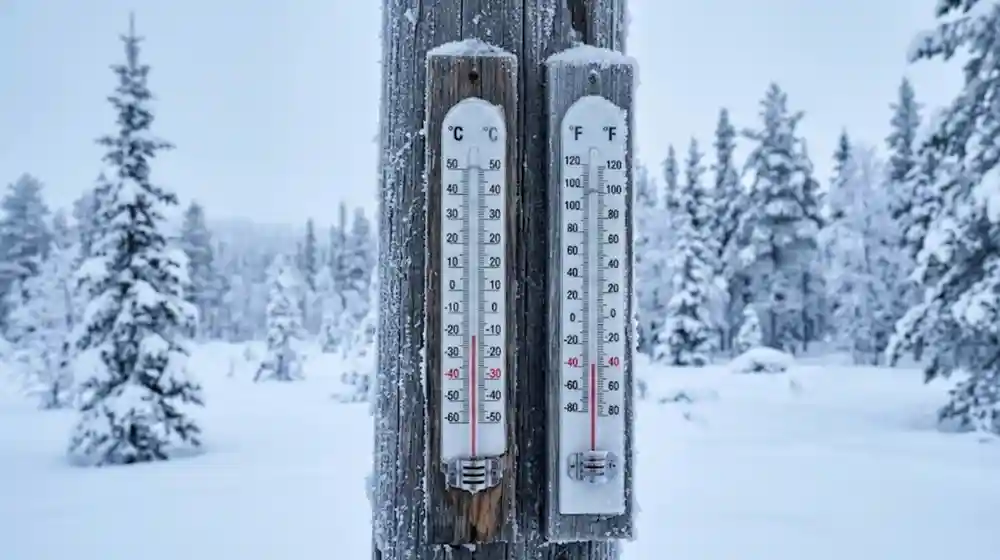
Temperature can be surprisingly confusing- especially when you switch between Celsius and Fahrenheit. A question many people search online every winter is: which is colder: minus 40°c or minus 40°f? It sounds like a trick question, but it has a fascinating answer.
The trust is simple: minus 40 degrees Celsius and minus 40 degrees Fahrenheit are exactly the same temperature. They are equal. At -40, the Celsius and Fahrenheit scales intersect at the same point. That makes it one of the most interesting temperature facts in weather, science, and everyday life. Whether you are ever looking at a weather forecast, traveling internationally, helping with homework, or just curious about temperature conversions, knowing which is colder: minus 40°c or minus 40°f? is both useful and memorable. And when someone asks you the same question, the right answer is: neither. They are the same temperature. It is one of the very few numbers where both measurement systems match perfectly.
Why are Celsius and Fahrenheit Usually Different?
To understand which is colder: minus 40°c or minus 40°f?, it helps to see how each scale works.
Celcius Scale
Celsius is the temperature system used by most countries in the world. It is based on water:
- Water freezes at 0°C
- Water boils at 100°C
It is very closely related to science and the metric system is therefore widely used in weather forecasts, education, medicine and research.
Fahrenheit Scale
Fahrenheit is used primarily in the United States and a few other places.
In Fahrenheit:
- Water freezes at 32°F
- Water boils at 212°F
Meaning the Fahrenheit scale uses smaller degree increments than Celsius.
The reason why the numbers are different is that the scales start at different points and go up at different rates. So if you look at temperatures, they usually have different numbers.
For example:
- 0°C = 32°F
- 20°C = 68°F
- 30°C = 86°F
But at -40, the numbers are exactly the same.
The Math Behind -40°C = -40°F. The reason they are the same is mathematical. To convert Celsius to Fahrenheit :
°F = ( °C × 9/5 ) + 32
If we plug in -40 : °F = ( -40 × 9/5 ) + 32 °F = -72 + 32 °F = -40 So : -40°C = -40°F
To check the opposite : °C = ( °F − 32 ) × 5/9 Plug in -40 : °C = ( -40 − 32 ) × 5/9 °C = -72 × 5/9 °C = -40 Same answer .
That’s why the answer never changes—whether you start with Celsius or Fahrenheit.
How Cold Does Minus 40 Feel?
While the math is interesting, most people want to know one thing:
How cold does -40 actually feel?
The answer: extremely cold—dangerously cold.
Minus 40 is severe winter weather. It’s cold enough to affect your body, vehicles, buildings, and daily routines within minutes.
At -40:
- Breath freezes into visible vapor instantly
- Nose hairs may freeze while breathing
- Car engines often fail to start
- Batteries drain much faster
- Ice forms quickly on windows
- Skin exposed to air can develop frostbite in minutes
If there’s wind involved, it feels even colder because of wind chill.
Places on Earth That Reach -40°
Although many people never experience -40 firsthand, several places around the world see it regularly.
Northern Canada
Areas in Yukon, Nunavut, and the Northwest Territories can reach -40 during winter. It’s not unusual there.
Alaska
Interior Alaska often experiences temperatures around -40 or lower in peak winter.
Siberia
Siberia is famous for brutal winters. Some towns there stay below -40 for long stretches.
Antarctica
Antarctica regularly records temperatures far below -40, especially during winter darkness.
Oymyakon
Oymyakon is often called the coldest inhabited place on Earth. Temperatures there can drop well beyond -40.
Common Temperature Conversions People Search For
Many people searching for which is colder: minus 40°c or minus 40°f? are also trying to understand how Celsius and Fahrenheit compare overall.
Here are a few common examples:
- 40 Degree Celsius to Fahrenheit
- 40 degrees Celsius to Fahrenheit equals 104°F.
This is very hot weather – common during summer heat waves in some countries.
40 Celsius to Fahrenheit
Similarly, 40 celsius to fahrenheit is 104°F.
That’s why 40°C often feels dangerously hot, especially with humidity.
40 Fahrenheit to Celsius
40 fahrenheit to celsius equals about 4.4°C.
That’s chilly but nowhere near freezing cold.
40 C to F
40 c to f also equals 104°F.
100 Degrees Fahrenheit to Celsius
100 degrees Fahrenheit to Celsius converts to approximately 37.8°C.
This is a very warm day and close to human body temperature.
These comparisons make it easier to understand how different Celsius and Fahrenheit usually are—and why the -40 crossover point is so unusual.
Why is -40 So Interesting?
Minus 40 is interesting because it’s unlikely mathematically and memorable in real life.
People remember it because:
- It’s the only common point where Celsius and Fahrenheit are equal • It’s a truly extreme weather point
- It’s in science classes and math problems
- It’s noticed by travelers switching through international weather apps
- It’s a great trivia question
Weather presenters and science teachers mention it often because it’s easy to remember once you learn it.
Is -40 the Coldest Possible Temperature?
No. Temperatures can go much lower than -40.
-50°
-60°
-80°
even colder in Antarctica
The lowest temperature ever recorded on Earth was below -89°C in Antarctica. Scientists also speak of absolute zero, the coldest temperature possible in physics. Absolute Zero Absolute zero is:
-273.15°C
-459.67°F
At that temperature, molecular motion pretty much ceases. So while -40 is very cold for humans, it isn’t the coldest possible temperature. I hope we have understood which is colder: minus 40°c or minus 40°f?
What Happens to the Human Body at -40?
Exposure to -40 without appropriate clothing can become dangerous very quickly.
Your body loses heat rapidly in these conditions.
Possible effects include:
- numb fingers and toes
- shivering
- stiff muscles
- reduced coordination
- frostbite
- hypothermia
With wind chill, frostbite can happen in under 10 minutes.
That’s why people in cold regions wear:
- insulated boots
- thermal layers
- heavy coats
- face masks
- gloves
- hats covering the ears
At -40, winter clothing becomes a safety necessity—not just comfort.
How Vehicles and Machines React to -40
Extreme cold affects more than people. Cars especially struggle in -40 weather.
Common problems include:
- dead batteries
- frozen fuel lines
- thick engine oil
- tire pressure drops
- frozen door locks
- poor traction on icy roads
In very cold places, drivers often keep engine block heaters plugged in overnight so the vehicle will start in the morning.
Electronics can also slow down or stop working properly in these temperatures.
Why This Temperature Matters for Travel?
If you’re traveling internationally, understanding -40 can help avoid confusion.
Imagine this:
A weather app says -40° but doesn’t show C or F.
Normally that would be confusing—but at -40 it doesn’t matter.
Celsius or Fahrenheit gives the same result.
That makes it one of the few temperatures travelers can instantly interpret regardless of which unit is being used.
Final Answer: Which is colder: minus 40°c or minus 40°f?
So let’s return to the original question: Which Is Colder: Minus 40°C or Minus 40°F?
Neither is colder. They’re exactly the same. -40°C = -40°F It’s the only point where the Celsius and Fahrenheit scales cross. While the two systems usually display very different numbers, minus 40 is where they perfectly match.
It’s also a reminder of just how extreme winter weather can become in some parts of the world. Whether you see -40°C on a Canadian forecast or -40°F on an Alaskan weather report, it means the same thing: extremely cold, severe winter conditions. And now if someone asks which is colder: minus 40°c or minus 40°f?, you’ll know the answer immediately—they’re the same.
Frequently Asked Questions
Which is colder: minus 40°c or minus 40°f?
-40°C and -40°F are the same temperature . This is the only temperature where the Celsius and Fahrenheit scales overlap, so neither is colder than the other.
Why do Celsius and Fahrenheit match at -40?
They match at -40 because of how the math works for the formulas that convert between the two scales. When you convert -40 from Celsius to Fahrenheit, or vice versa, you end up with the same number. This is the only commonly used temperature where both scales match exactly.
What is 40 degree celsius to Fahrenheit?
40 degrees Celsius to Fahrenheit equals 104°F. This is regarded as very hot weather and is common for summer heatwaves in many parts.
What is 40 celsius to fahrenheit?
40 celsius to fahrenheit is 104°F. It’s the same conversion and is often searched when checking the weather or converting temperatures for cooking and travel.
What is 40 fahrenheit to celsius?
40 fahrenheit to celsius equals approximately 4.4°C. The temperature is above freezing, but it feels cool.
What is 40 c to f?
40 c to f is 104 degrees Fahrenheit. You can convert it with the following formula: °F = (°C x 9/5) + 32
What is 100 degrees Fahrenheit in Celsius?
100 degrees Fahrenheit in Celsius is around 37.8 degrees Celsius. This is very warm and is close to the average human body temperature.
How cold is minus 40 degrees?
Minus 40 degrees is absolutely freezing and could be life-threatening if you are outside for too long. Skin can freeze over pretty quickly, you can experience sharp and icy breathing, and you can get frostbite in minutes if you aren’t dressed for the cold.
Where does it get to -40 degrees?
Temperatures of -40 can be found in places such as Alaska, Northern Canada, Siberia, and Antarctica during the winter.
Is -40 the coldest temperature on Earth?
No. -40 is actually pretty warm compared to some other places on earth. In some parts of Antarctica, temperatures have dropped below -89 °C, way colder than -40.
Also Read:
‘Weather in Greece in May?’ Know Right Time to Trip to Greece
2026 Winter Olympics Men’s Freestyle Skiing Big Air Results News!

I have been associated with IEMLabs over the last five years and have been creating content with a focus on increasing awareness of cybersecurity as the platform evolves. I have also been involved in creating various tech blogs, where I produce content beneficial to students, the workforce, and tech enthusiasts. My focus is on making complex issues, such as ethical hacking, AI, cloud computing, and emerging digital trends, simple and easy to read and understand. With a passion for digital literacy and cybersecurity education, I aim to create content that not only informs but also empowers individuals to navigate the evolving technological landscape with confidence.