

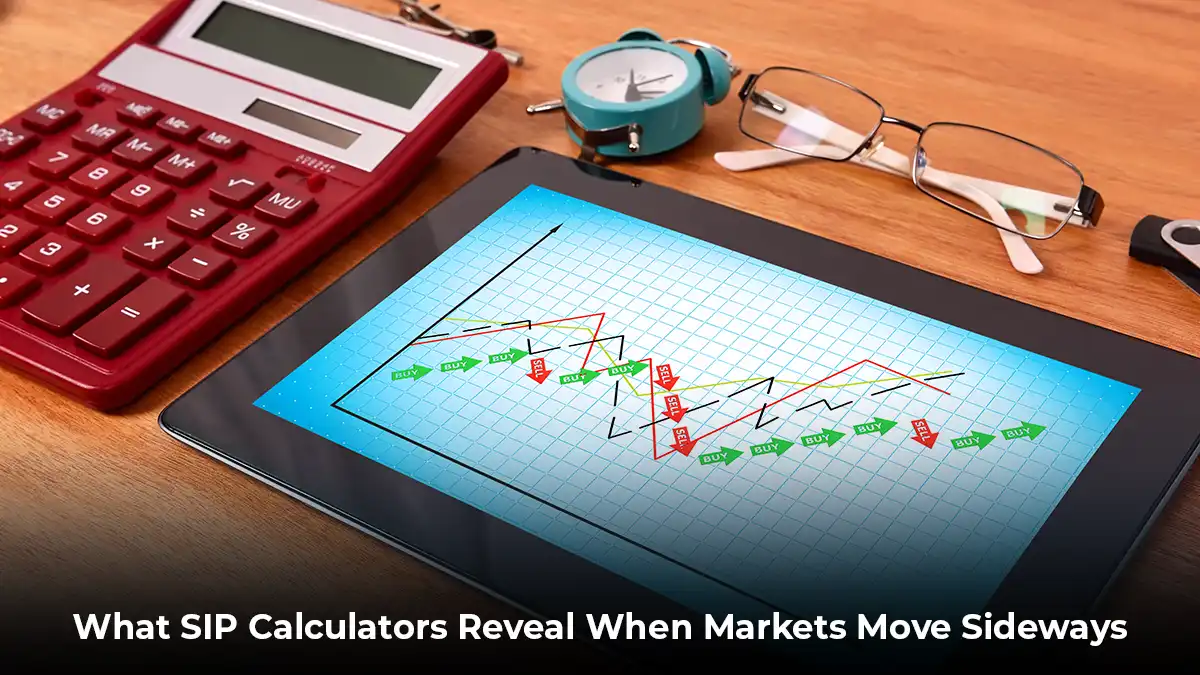
Often the behavior of the markets will limit upward and downward movement or crash as they may trade sideways for a prolonged period while being contained in a very small range of prices. During these types of market environments, most investors tend to be anxious and impatient, while SIP investors continue to monitor closely their investment results.
A SIP Calculator is beneficial when attempting to understand what is happening behind the scenes of a flat return.
Let’s understand what really happens when markets stay range-bound.
What Is a Sideways Market?
A sideways market (range-bound or flat) refers to a market in which the price of a security does not exhibit clear upward (bullish) or downward (bearish) momentum; it moves back and forth in a range without a significant upward or downward trend.
While they can exhibit relatively flat or uninspiring returns, short time frames in a sideways or range-bound market can leave investors confused and unsure as to how best to proceed.
Here we see SIP behaviour become relevant.
How Does SIP Work in a Sideways Market?
A SIP is simply an investment of a fixed dollar amount (or share amount) at regular intervals (daily, weekly, monthly) regardless of how prices are moving in the market. So when prices dip, your fixed amount buys more units. When prices rise, it buys fewer units. This process is called rupee cost averaging; in simple terms, your average purchase cost gets balanced over time.
Even if the NAV looks stagnant for months, your total units may keep increasing quietly. That’s the key point: sideways markets could help you build quantity, not immediate returns.
What Can a SIP Calculator Reveal
Impact of Volatility on Average Cost
A SIP Calculator may show how small ups and downs could work in your favour. Because you keep investing regularly, your average cost per unit typically reduces over time. Even if the market does not show strong growth, the fluctuations can help balance your buying price. So while returns may look flat, your cost efficiency can potentially improve.
Power of Time
When you extend the timeline, calculators reveal something important: flat phases don’t last forever. Once the market trend resumes, the large number of accumulated units may start compounding and that’s when growth may become visible.
Consistency Beats Timing
If you pause your SIP during a sideways phase, calculators may show how much future value you may lose. SIPs can help you accumulate units for market growth as evidenced by remain flat for three to four years.
Emotional vs. Mathematical Reality
Perceptions of a non-moving sideways market may create the false impression of no activity. Your portfolio may appear static, even though the underlying assets are maintaining their value.
But mathematically, something important may be happening: your units may be steadily increasing. A SIP Calculator could make this hidden progress visible. It shows how your regular investments are building a base for potential future growth. When the market eventually breaks out of the range, long-term investors may reap benefits. In such phases, patience matters far more than prediction.
Common Mistakes Investors Make During Sideways Markets
During sideways markets, investors may feel uncertain about their portfolio performance. During these times, typical behavior includes:
– Temporary suspension of SIP contributions.
– Performance evaluations over 6-12 months.
– Continually switching between funds to find short-term success one’s investment strategy may have worked last year, but not necessarily in the future.
– Ignoring the long-term effects of compounding that can take several years to show up in your portfolio.
Conclusion
Even though sideways markets can feel like they aren’t doing anything for one’s portfolio, they can still build portfolio resiliency. In fact, during periods of sideways market activity, investors can use consistent investments to build more units than would otherwise be possible. Using an SIP calculator is an ideal way to illustrate how these periods are generally associated with a long-term accumulation of units rather than an immediate increase in value.
Over the long term, staying consistent during relatively calm phases could influence overall outcomes.

I am a content writer with proven experience in crafting engaging, SEO-optimized content tailored to diverse audiences. Over the years, I’ve worked with School Dekho, various startup pages, and multiple USA-based clients, helping brands grow their online visibility through well-researched and impactful writing.